

The $2,900 Decision: When Renting Servers Becomes a Financial Prison
Key Takeaway
A single $2,900 investment can save over $3,400 annually with an eight-month ROI. After that initial period, the savings become pure profit while maintaining complete infrastructure control.
The Financial Confrontation
Today we're unpacking a critical feasibility study that forces a big confrontation between renting servers in the cloud and actually owning your own hardware. The financials here are the immediate hook: a single $2,900 investment projected to save over $3,400 every single year, translating to an eight-month return on investment. After that milestone, the ongoing savings become pure profit.
The Rental Car Analogy
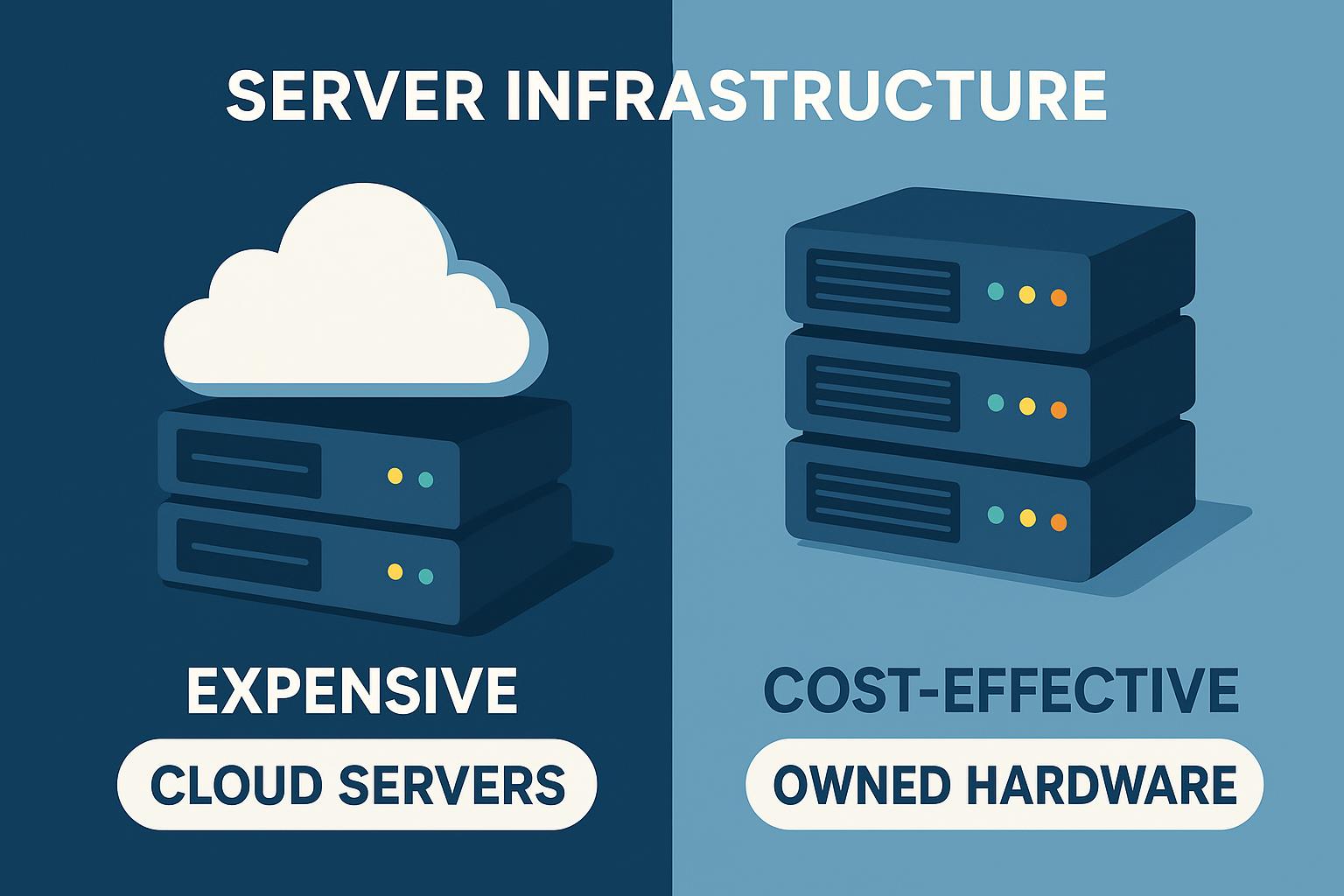
Let's use the analogy from the study because it really paints the picture. Currently, many businesses are paying about $360 a month to rent ten servers on AWS LightSail. The proposal is straightforward: buy ten faster, dedicated servers for that one-time cost and then simply stop paying rent. The financial logic seems obvious, but the real problem isn't even the $360 monthly fee—it's what you're not getting for that price.
The Hidden Cost of Throttling
That seemingly attractive price point is only possible because these are burstable instances, which sounds fine until you experience a burst of customers. When demand peaks, the servers get throttled—they slow down precisely when you need them most. This is the hidden cost that transforms an apparent bargain into a business liability.
The Staggering Reality
If you wanted always-fast instances in the cloud with guaranteed performance and no throttling, that $360 bill would explode to roughly $911 per month. Every single month.
When you compare that to the Wise Cluster's ongoing cost—basically just electricity at around $75 a month—suddenly buying the hardware isn't just an option. It becomes a financial necessity.
The Strategic Solution: ZimaBoards and Proxmox
The specific solution involves a ten-node cluster using ZimaBoards for two critical reasons. First, the setup uses Proxmox, which provides high availability. If one server node fails, the others automatically take over with zero downtime. But the ZimaBoard itself represents the real strategic piece.
It features a special video acceleration chip built directly into the hardware. This chip enables the CTO's new product vision—WiseWare Business Workspaces. This little component handles high-performance desktop streaming, essentially creating a personal Netflix server for your computer screen. This experience would be incredibly expensive to replicate in the public cloud, but here it's basically free because it's baked into the hardware.
The Vendor Lock-In Trap
This makes the migration particularly urgent. If you start building new products in the cloud, you run directly into the vendor lock-in trap. Once your software and data are built on their platform, extracting them later becomes a nightmare—incredibly complex and prohibitively costly.
This isn't merely theoretical. Industry reports document huge enterprises spending millions on what they call "repatriation projects"—just to escape this exact trap and bring their data back home.
The Hybrid Approach
The new strategy isn't about abandoning the cloud completely. It's a smart, defensive hybrid approach. You maintain your sovereign core on the Wise Cluster for key operations, but you still leverage multi-cloud vendors like AWS or Google for cheap, non-critical services—nightly backups, disaster recovery, and other scenarios where you're primarily storing data and cost is the main factor.
The Bottom Line
The $2,900 investment becomes pure profit in just over eight months and yields $3,400 in savings every year after that—minimum.
The comparison is stark: $911 per month in the cloud for guaranteed speed versus $75 per month to own it yourself. This difference illustrates how scaling in the public cloud can become financially ruinous very quickly, while scaling on hardware you own costs almost nothing extra.
The Provocative Question
When does the convenience of renting your core business infrastructure become a permanent, cost-prohibitive prison?
For businesses currently relying on cheap cloud infrastructure, this question demands serious consideration. The answer might determine whether your company maintains financial flexibility or becomes trapped in an escalating cost structure that makes scaling prohibitively expensive.
This blog post is based on our comprehensive feasibility study analyzing the financial and strategic implications of infrastructure ownership versus cloud rental. For detailed technical specifications, ROI calculations, and implementation strategies, please refer to the complete study.